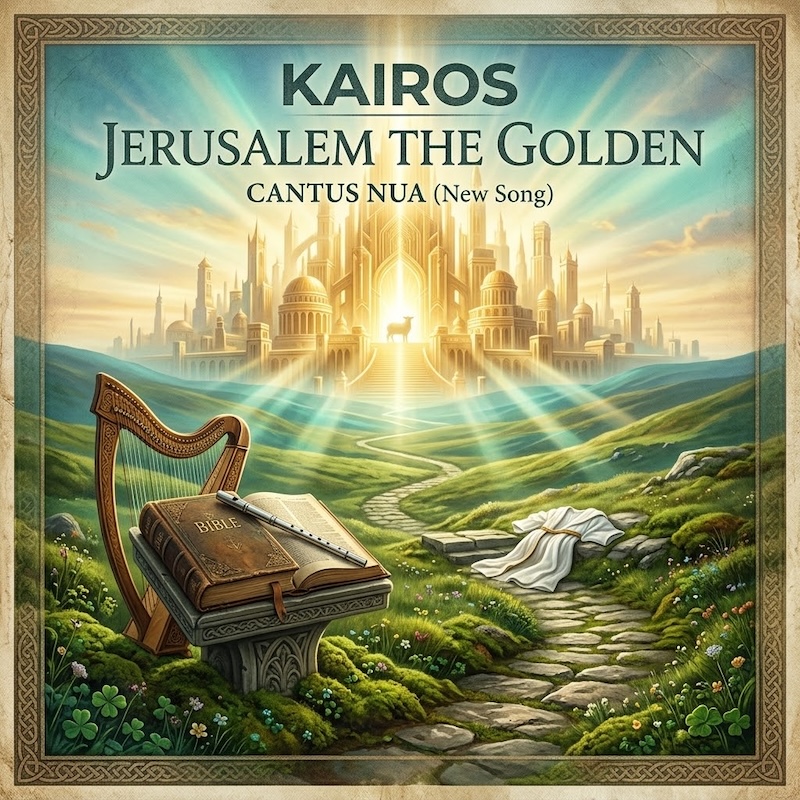
Cantus Nua · Track 2
Jerusalem the Golden
Revelation 21:1–4 ☩ Revelation 7:9–17 ☩ Isaiah 25:6–9 ☩ Revelation 22:1–5
Lyrics
Verse 1Jerusalem the golden, with milk and honey blest –
The sight of it refreshes the weary and oppressed;
I know not, oh, I know not, what joys await us there,
What radiancy of glory, what bliss beyond compare;
To sing the hymn unending with all the martyr throng,
Amidst the halls of Zion resounding full with song.
Verse 2Oh, sweet and blessed country, the home of God's elect!
Oh, sweet and blessed country, that eager hearts expect,
Where they who with their Leader have conquered in the fight
For ever and forever are clad in robes of white.
Jesus, in mercy bring us to that dear land of rest,
Where sings the host of heaven Your glorious name to bless.
Verse 3The Christ is ever with them; the daylight is serene.
The pastures of the blessed are ever rich and green.
There is the throne of David; and there, from care released,
The shout of them that triumph, the song of them that feast,
To God enthroned in glory the Church's voices blend,
The Lamb forever blessed, the Light that knows no end.
Notes from Tom
Old words, an old tune, and a new arrangement. Both halves of this song have a story worth telling.
The words: a monk's complaint that turned into a vision
Around the year 1145, a Benedictine monk named Bernard of Cluny sat down and wrote a poem of about three thousand lines called De Contemptu Mundi, "On Contempt of the World." Almost nothing is known about the man himself. Even his birthplace is disputed; different sources place him in Morlaix in Brittany, Morlaàs in the Pyrenees, or Morval in Burgundy. What survives is the poem, and the poem is a strange and wonderful thing.
Most of it is a blistering satire. Bernard looks at the church and the world of his day and sees greed, lust, corrupt clergy, corrupt popes, and a general rot he cannot stay quiet about. He wrote it in a brutally difficult meter, a form of dactylic hexameter with internal rhymes stacked on top of end rhymes, and he confessed in his preface that he could never have finished it "in so difficult a metre" without help from above.
But the poem opens with something else entirely. Before the complaint comes the vision: a picture of the heavenly Jerusalem, the country of the blessed, the feast that never ends. Bernard could only write so sharply about the world's failures because he had first looked long and hard at the world to come.
Seven hundred years later, an English clergyman named John Mason Neale found the poem, or rather the opening of it. Neale was the great Victorian translator of ancient hymns; we owe him "O Come, O Come, Emmanuel," "Good Christian Men, Rejoice," and "All Glory, Laud, and Honor," among many others. In 1851 he published a translation of the heavenly-vision section, and in 1858 a fuller version of about 218 lines. He did not try to reproduce Bernard's impossible meter. He converted it into plain English quatrains that a congregation could sing, and from those lines four hymns were carved out: "The World Is Very Evil," "Brief Life Is Here Our Portion," "For Thee, O Dear, Dear Country," and the one that outlived all the rest, "Jerusalem the Golden."
The verses here are the three most hymnals keep. The first is Bernard's longing: I know not, oh, I know not, what joys await us there. The second is the country itself and the ones who have made it home, clad in robes of white, and the prayer to be brought there too. The third is the arrival: Christ present, the pastures green, the throne of David, and the shout of them that triumph, the song of them that feast.
The tune: Holst, Jupiter, and a village called Thaxted
Most hymnals pair these words with a tune called EWING, written by a Scottish amateur named Alexander Ewing in the 1850s. It is a fine tune. This is not it.
The melody here belongs to Gustav Holst. Between 1914 and 1916 Holst wrote The Planets, and the fourth movement, "Jupiter, the Bringer of Jollity," has at its center a broad, stately hymn-like melody that stands apart from everything around it. In 1921 Holst was asked to set a poem by the diplomat Cecil Spring Rice, "I Vow to Thee, My Country." Overworked and short on time, he realized the Jupiter melody already fit the words almost perfectly, and he lifted it out, adjusted a few notes, and named the resulting hymn tune THAXTED after the village in Essex where he lived.
That is where most people have heard it. "I Vow to Thee, My Country" became something close to a second national anthem in Britain. It is sung on Remembrance Sunday, at royal weddings and funerals, and at state occasions; it was Princess Diana's choice for her wedding and was sung again at her funeral. In the United States the tune turns up in a different place: a 1982 text by Michael Perry, "O God Beyond All Praising," which many American churches now sing to it. Either way, THAXTED carries a weight of solemnity and grandeur that few hymn tunes can match, and that is exactly why it belongs with Bernard's vision of the golden city.
A note on the music
The old tune and the old words are both kept intact. The arrangement is what is new, and I kept it simple: a piano carries it, with a violin above that brings a little bit of an Irish folk-music flair, and a bass and drum kit underneath. The male and female voices mostly take their own turns, coming together as a duet at a few key moments, and the whole song builds toward the third verse. That is where it lands, on the line that is the heart of the whole hymn: the shout of them that triumph, the song of them that feast. It is sung right at the edge of a shout, still on the melody but with everything behind it, because that is what the line is describing. Not a quiet hope. A feast, and a crowd of people who have already won.
There is another version of this one with a saxophone solo in it, which is pretty cool. It isn't the one here, but if you'd like to hear it, [email me](mailto:kairos316music@gmail.com) and I'll send it along.
from Cantus Nua, released September 29, 2026
Lyrics and tune, Thomas J Bernthal, SDG